
Platinum
Being one of the metals with a high melting point, it has to reach 3,200 degrees Fahrenheit to change its solid state and melt.
Platinum is considered a precious metal, and some people value it more than gold. This material is commonly found in the jewelry industry, but the automotive world also demands it. Platinum is the main ingredient in catalytic converters for cars, which is also the most expensive part of a vehicle.
Solder
Solder does not have a fixed melting point. Its state changes when it reaches a temperature between 190 to 840 degrees Fahrenheit.
It is a metal alloy used to create permanent bonds. For example, in circuit boards, the solder will be used to join copper together. Solder can also be in two different types, lead and lead-free. Other uses include electronics, heating, and air conditioning.
Stainless steel
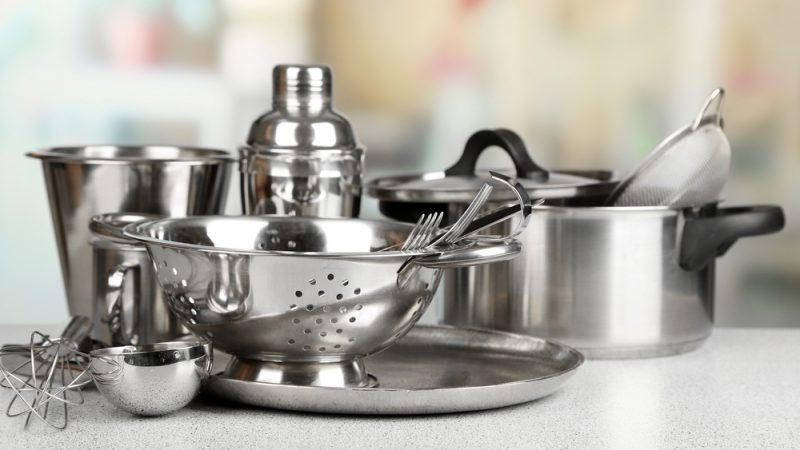
Stainless steel has a melting point between 2,550 and 2,700 degrees Fahrenheit.
It is mainly used for cookware and kitchen utensils due to its corrosion-resistant properties. Foods with high acidity can cause damage to some metals. Still, stainless steel is highly resistant to them and doesn’t affect their flavor.
Zinc
Zinc has a melting point of 786 degrees Fahrenheit. You should wear protective equipment when melting this material because it releases zinc oxide smoke.
Many products use zinc, with three-fourths of this material being consumed as metal. It offers corrosion protection to iron and steel as a coating. Still, it is also used as an alloying metal to make bronze and brass.
Mercury
Only one metal is liquid at room temperature, and that is mercury. While others have a relatively high melting point, this one melts at -37.89 degrees Fahrenheit.
Mercury has many uses, and surely you have already worked with it. Commonly found in thermometers and pressure measuring devices, mercury is always the top choice due to its high density. The electronics industry finds this material useful as it is used in various components and electrical switches. Other uses include dental fillings, batteries, and even soaps.
Uses:
- Scinetific instruments
- Barometers
Nickel
Because it is one of the hardest metals, nickel melts at a very high temperature. You need to reach 2,651 degrees Fahrenheit to transform it into a liquid state.
The electronics industry also uses nickel, which is commonly found in batteries. It includes the ones you have in your TV remote. It was also the main metal used for coins throughout history because it is not that expensive to extract and process.
Nickel:
- Armour plating
- Turbine blades
- Boat propeller shafts
Magnesium
Before you consider melting magnesium, it is important to wear protective equipment. When you burn this metal, fumes of magnesium oxide will make the air dangerous to breathe. The melting point of magnesium is 1,202 degrees Fahrenheit.
Because it is so lightweight, this metal is used in various applications. Many companies worldwide continuously demand magnesium, from luggage to laptops and cameras. During the 4th of July and New Year’s Eve, this metal is also responsible for lighting up the night sky as it is commonly used in fireworks and flares.

