
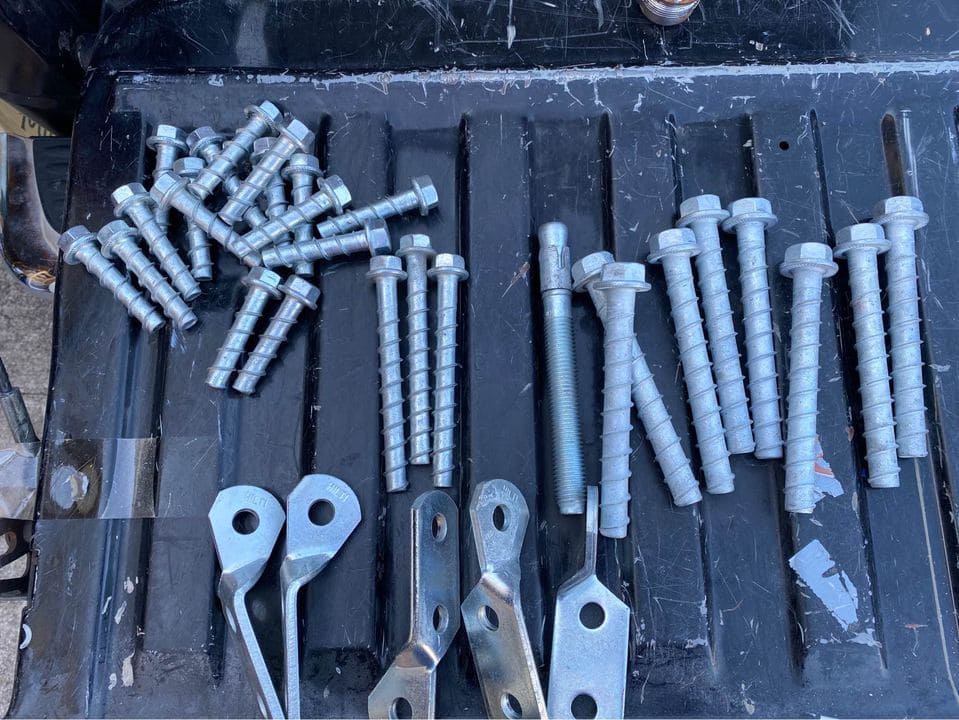
Picking the right type of concrete fasteners can be troubling, especially when you’re a newbie in the masonry field. Different types have different capabilities and choosing the wrong one might result in a destroyed project or money and time loss.
That’s why we’ve provided a list of categorized fasteners, with tips on how and when to use them. These tools can be divided into three main categories, depending on the load amount:
| Types of fasteners | |
| Light duty | More flexible and less sturdy |
| Medium duty | Medium flexibility and sturdiness |
| Heavy duty | Less flexible and sturdier |
Light Duty
Tools in this category are best for detailed, lighter constructions. Using them with bigger loads might result in the anchor’s deformation or complete construction collapse. They are often more flexible and bendable than other types. They include:
- Plastic – is very popular and easy to purchase. These are great for installing shelves, bars, and shelf brackets. To install them, put anchors into a drilled hole and then thread the screws through the plastic and into the holes.
- A soft metal shield is a classic choice still holding up to its former fame. They work especially well when dealing with angles and bends that would otherwise pose a problem to classic screws. They are very flexible, allowing for any shaping needed. To use them, wrap them around the desired material like a strap. Put a screw through both ends of this strap into a wall.
- Hammer-set – fantastic for fur straps and other hanging constructions. They’re easy to install and don’t require advanced tools. The only thing you need to do to put this fastener to work is to drill a hole for it. Then hammer the pin into the hole.
Medium Duty
Not as strong as heavy duty, not as flexible and delicate as light duty. These tools are right in the center and can probably carry most of the typical work due to their average statistics. They might be capable of handling heavy-duty work, although using them this way is risky. These are:
- Sleeve anchors- being able to withstand the force of 200lbs, this is a big step-up from the previous tools. This variation is great for handlebars and brackets and works best when used against lighter masonry. To use it, drill a hole and put the shield of the tool into it. Pushing the desired material against the hole, thread the two with a screw and tighten them together.
- Concrete screws- ideal for fastening electrical boxes, doors, and windows. Unfortunately, some heavier tools will be needed with this one. When drilling the especially hard heads into the concrete, you’ll have to use a power drill. Then, insert the fastener into a drilled hole.
Heavy Duty
There are not that many types of fasteners that are able to withstand the biggest of weights. Most variations will break, bend, or otherwise destroy the construction when exposed to a significant force.
That’s why there are only two types of tools that can be used for heavy-duty: bigger Sleeve anchors and wedge anchors. They perform similarly, with the wedge one being a more durable version of the sleeve one. They’re both inserted in the same way and are used for the same things, such as frames and wooden plates.
You have to look at the weight required, the type of job you’ll be doing, and what materials you’ll be using when searching for a concrete fastener. There are also obvious factors, such as budget, company’s reputation, and user opinion.

